
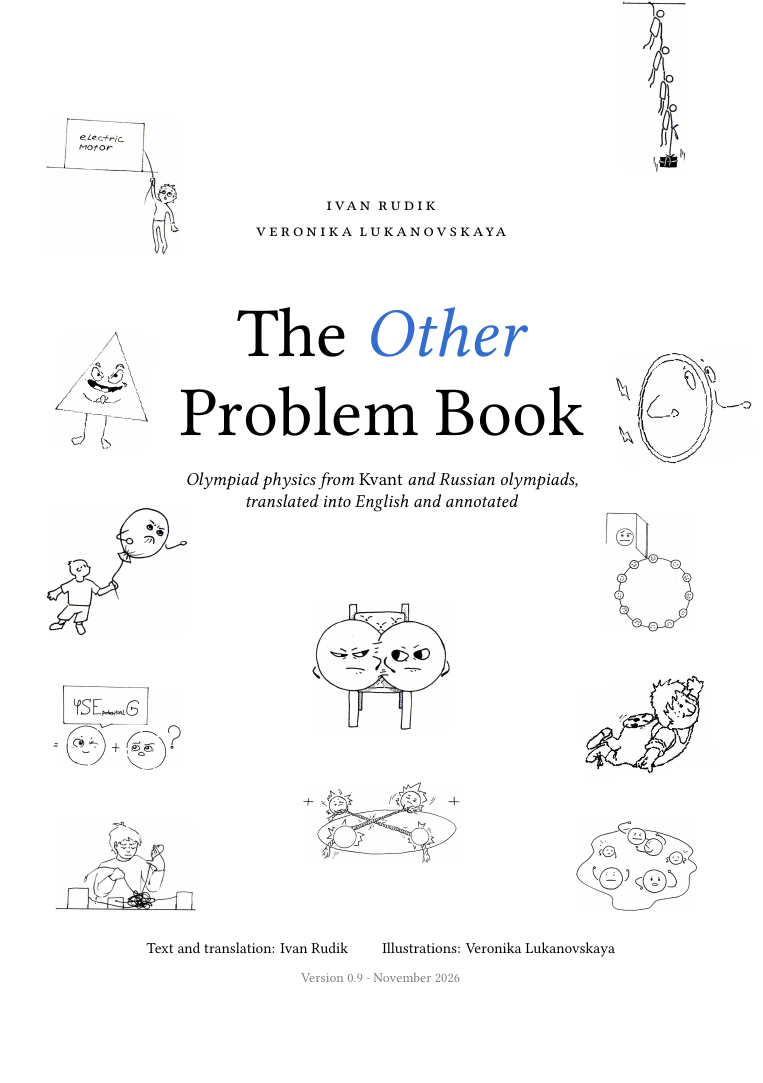
Cover of The Other Problem Book

ivan rudik · veronika lukanovskaya

The Other
Problem Book

Fifty olympiad physics problems from the magazine Kvant and from Russian olympiads, translated into English and solved step by step, with every figure redrawn and illustrations by Veronika Lukanovskaya. For students preparing for physics olympiads, and for anyone who enjoys a good problem.

Download the PDF Try a problem

Free · PDF, 162 pages, 7.2 MB · Version 0.9, November 2026

what is inside

At the end of the book: short answers to all fifty problems, an index of the methods used in the solutions, and the sources of every problem.

look inside

A few pages

Scroll sideways · click a page to enlarge

try a problem

Before you download

Vessel with Water

Problem 5 · from Kvant, 1979, No. 10

Problem. On a horizontal surface stands a vessel filled with water, closed on top by a light movable piston bearing a heavy load of mass M. There is an orifice of cross-section s at the bottom of the vessel through which water flows out. What steady speed of motion of the vessel will be established if the friction force between the vessel and the surface is proportional to the vessel’s speed, the proportionality coefficient being k? The cross-sectional area of the vessel is S.
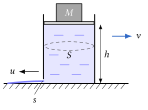
Vessel with water, a piston with a load M, and an orifice near the bottom
Fig. 5.1

Think about it for a few minutes. What pushes the vessel, and how fast does the water leave it?


Solution. Here we will use the formula for the reactive force: Each element of the fluid carries away a momentum , thereby creating an impulse of force that pushes the vessel forward. The steady speed v is determined from the condition that the friction force and the reactive force are equal:

To find the reactive force, pass to the reference frame moving with speed v; in this frame the vessel is at rest. When a small mass Δm of water flows out, its kinetic energy equals the decrease of the potential energy of the water, , and of the load, : The water level drops by , so If the load is heavy, , the first term can be neglected and the outflow speed is practically constant: .
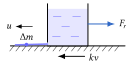
Forces on the vessel: the reactive force and the friction force
Fig. 5.2

Now the reactive force is and the speed of the vessel is

Forty-nine more problems like this one, with figures and full solutions, are in the book.

Download the PDF
contents

The problems

Part I · Problems 1–10
  1. Partially Charged Cylinder
  2. From the Hole onto the Field
  3. Remembering the 1990s
  4. Fan Thrust
  5. Vessel with Water
  6. Gas Circle
  7. Sealed Tube with Mercury
  8. Balloon with a Vent Hole
  9. Chain
  10. Two Balls
Part II · Problems 11–20
  1. Statically Indeterminate Systems
  2. Thin Hoop Rolling Inside a Cylinder
  3. Mean Free Path of Air Molecules
  4. Heat Capacity of a Gas with a Spring-Loaded Piston
  5. Water Vapor in an Evacuated Vessel
  6. Gas and Mercury Column in a Vertical Tube
  7. Adiabatic Flow of Moist Air over a Mountain Ridge
  8. Temperature vs. Altitude in an “Adiabatic” Atmosphere
  9. Charging an Accumulator with Motors Used as Generators
  10. Cycle Efficiency
Part III · Problems 21–30
  1. Piston Motion During Heating and Evaporation of Water
  2. Adiabatic Compression of Saturated Water Vapor
  3. Charged Particle at the Center of a Charged Ring
  4. Surface Charge Densities on Two Parallel Metal Plates
  5. Two Thin Concentric Conducting Spheres
  6. Potential of a Charged Conducting Sphere in the Presence of a Point Charge
  7. Circuit of Capacitors
  8. Planar Diode with Space Charge
  9. Two Metallic Rings
  10. Pseudo-experiment “Viscous Friction”
Part IV · Problems 31–40
  1. Triangle and Film
  2. Rotating Sleeve
  3. Adiabatic Anisotropy
  4. Silvered Cone
  5. Current Stabilizer
  6. Surely Not Snellius?
  7. I Put on My Glasses
  8. The Research Probe
  9. Impulse Acceleration
  10. Lord Kelvin’s Archive
Part V · Problems 41–50
  1. Ball on a Spring Inside a Sphere
  2. A Luminous Sphere, a Lens in an Aperture, and a Light Cone
  3. The “Narrowing” Mirror Cylinder
  4. Bulbs…
  5. Two Pistons and Two Springs
  6. Two Perpendicular Hemispheres
  7. The Rod and the Body
  8. Hop, Hop, Hop…
  9. Diode–Lamp Circuit
  10. Linear Oscillations in an Anisotropic Quadratic Potential

authors

Who made it

Ivan Rudik

Text, translation and solutions.

Veronika Lukanovskaya

Illustrations and comics.

license

Free to share

The book is licensed under CC BY-NC-ND 4.0. You may copy and share it free of charge, without changes and with credit to the authors.

The license covers the authors’ own contribution: the translation, solutions, figures, illustrations and layout. The original problems belong to their authors and are credited on the Sources page of the book.

Questions, errors, or you are the author of a problem and want it removed? Write to hello@theotherproblembook.com.